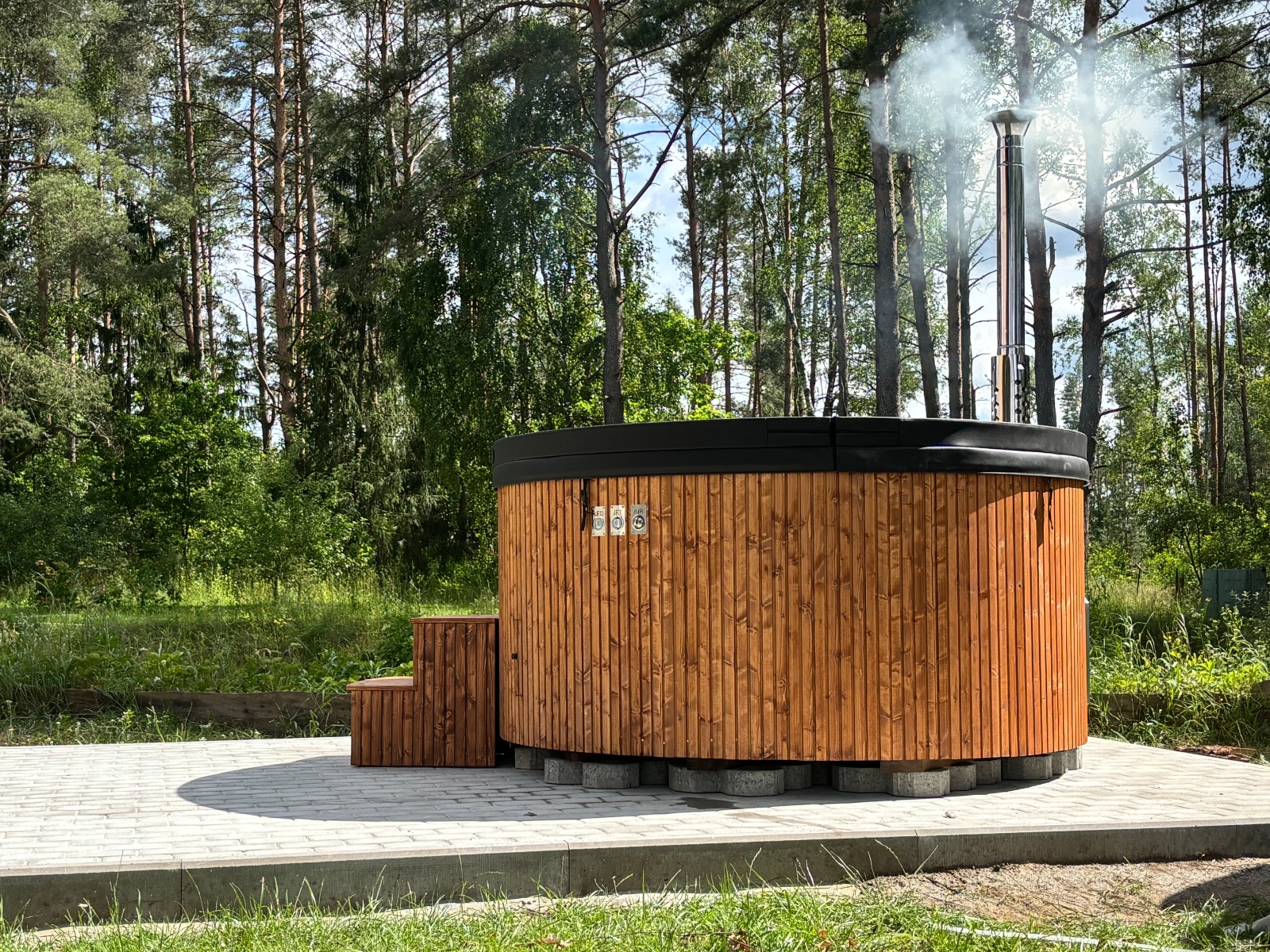
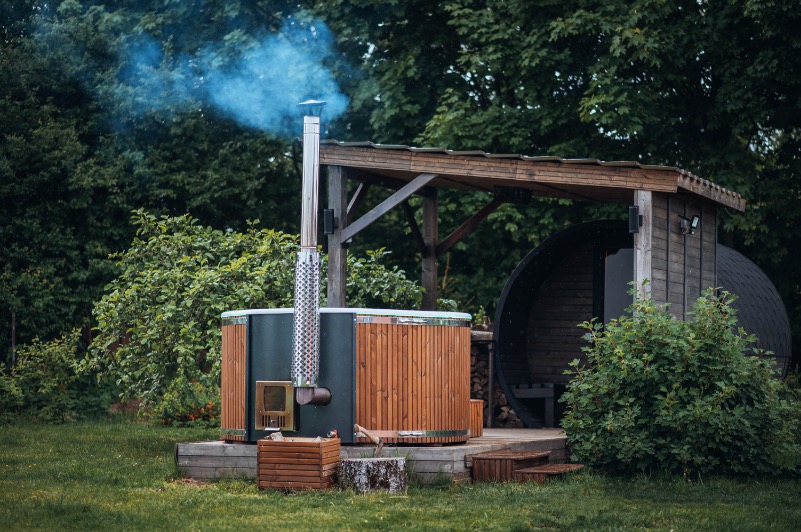
Choosing an outdoor hot tub is not only about the shape, size or finish. One of the most important decisions is how the water will be heated. At Maudis, we offer hot tubs with wood-fired heating, electric heating and hybrid configurations combining both systems. The right choice depends on how often you plan to use the hot tub, how you want to heat and maintain the water, how much space is available around the tub and which heating system is compatible with the selected insert.
A wood-fired system can be ideal for planned bathing sessions and for people who enjoy the process of lighting and maintaining a fire. Electric heating is more convenient for frequent use, programmed heating and maintaining a selected temperature. A hybrid system can combine both experiences.
The important point is that the heater should not be selected in isolation. Its position, construction and compatibility have to be considered together with the hot tub insert, technical equipment and the way the hot tub will actually be used.
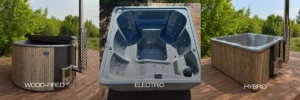
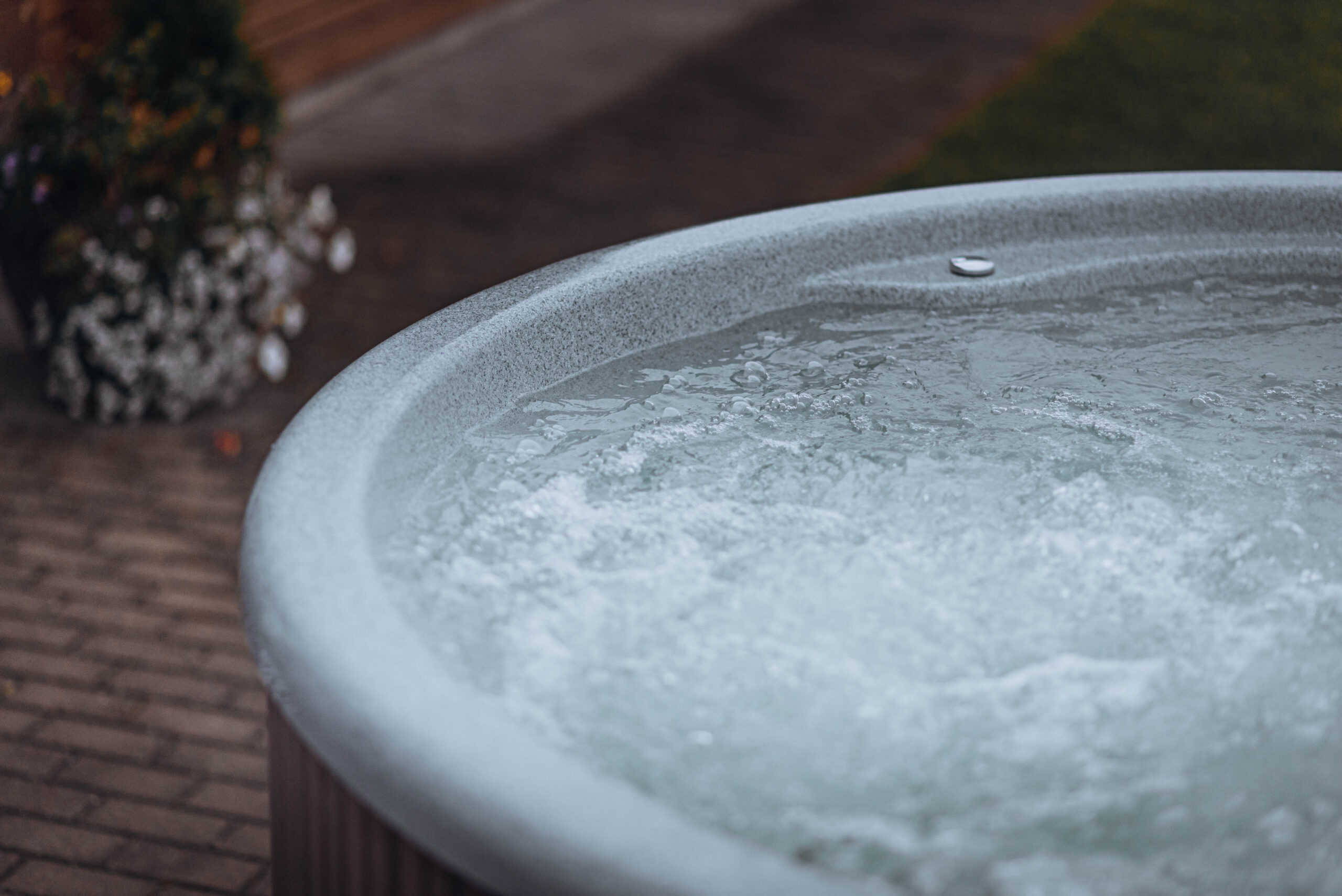
Examples of Maudis hot tubs with wood-fired, electric and hybrid heating. The exact heater position and equipment depend on the selected hot tub model and insert.
Wood-Fired vs Electric Hot Tub at a Glance
Compare the key differences to find the right heating system for your lifestyle.
| Feature | Wood-fired hot tub | Electric hot tub | Hybrid hot tub |
|---|---|---|---|
| Heating process | Manual fire heating | Thermostatic electric heating | Wood-fired and electric heating |
| Temperature control | Manual | Set and maintain the temperature | Fast heating with wood and automatic temperature maintenance |
| Firewood required | Yes | No | Optional |
| Fire supervision | Required during heating | No fire supervision | Required when using wood |
| Programmable heating | No | Yes | Yes |
| External space required | Depends on the heater | Technical equipment only | Depends on the configuration |
| Best suited to | Planned bathing sessions | Frequent, controlled use | Frequent use and flexibility |
| Main consideration | Firewood, chimney and manual control | Electrical infrastructure | Compatibility and technical space |
Heating time and operating costs depend on water volume, starting temperature, outdoor conditions, insulation, the cover, heater parameters and local electricity or firewood prices. This table provides a general comparison of the main differences.
How does a wood-fired hot tub work?
A wood-fired hot tub heats water through a stove connected to the hot tub. Before heating, the tub must be filled to the required water level, suitable dry firewood prepared and the fire started. The heat intensity is controlled manually through the amount of fuel and airflow. During heating, the water temperature needs to be monitored and the water should be circulated or mixed sufficiently for the temperature to distribute evenly.
Unlike an electric system, a wood-fired heater does not have a thermostat that automatically maintains an exact water temperature. Once the fire goes out, the water will gradually cool rather than being automatically reheated. This makes wood-fired heating particularly suitable for people who use the hot tub for planned bathing sessions rather than expecting it to remain at a precise temperature between uses.
There is also a practical difference in the experience itself. For many owners, heating the tub is part of the ritual: preparing firewood, lighting the stove and watching the water gradually reach bathing temperature.
Three wood-fired heater designs from Maudis
Maudis uses three different wood-fired heater constructions:
1. Integrated wood-fired heater
2. External wood-fired heater
3. Integrated FLAT wood-fired heater
The difference is not simply where the stove is located. The heater must be compatible with the shape of the hot tub insert.
| Wood-fired heater type | Heater position | Insert design | Standard material | AISI 316 option | What to consider |
|---|---|---|---|---|---|
| Integrated heater | Integrated below insert | Raised seating above the heater | AISI 304 | Available | Uses interior space but keeps the exterior compact |
| Integrated FLAT heater | Integrated below insert | No raised heater section required | AISI 304 | Available | Fits selected external-heater inserts, including Ofuro. |
| External heater | Beside the hot tub | Fully round inserts or Ofuro | AISI 304 | Available | Preserves interior space but requires a level area beside the hot tub for the heater. |
1.Integrated wood-fired heater
The standard integrated heater is installed inside the hot tub and occupies part of the insert. Because of this, the insert needs a specially moulded raised section designed for the heater. From inside the hot tub, this area appears as a raised continuation of the seating area, while the heater body is positioned underneath it.
A practical example is the Maudis 3D QUADRO SPA wood-fired hot tub, where the heater is integrated beneath the specially moulded raised seating section.
This construction has several practical advantages:
- the heater does not stand separately beside the hot tub;
- the outside composition remains compact;
- the hot tub can be easier to position close to other outdoor structures;
- the insert itself is specifically designed around the heater.
The compromise is that the heater influences the internal geometry and available seating space.
However, the raised area can also function as a higher seating position for children, whose feet may
otherwise not comfortably reach the bottom in a deeper hot tub. Children must always be supervised
by an adult and this should not be interpreted as a safety feature that permits unsupervised use.
2.External wood-fired heater
An external heater stands next to the hot tub and is connected to the insert through water connections. The main advantage is straightforward: the heater does not take up space inside the insert. This can be particularly relevant when the priority is maximum internal space or when the hot tub is intended for a larger group.
However, the external heater changes the planning requirements. Space must be left beside the tub for:
- the heater itself;
- water connections;
- the chimney;
- safe access for loading firewood;
- maintenance.
This becomes particularly important when a hot tub is built into a terrace. The heater and its connections must remain accessible rather than being permanently enclosed by the surrounding structure.
3.Integrated FLAT wood-fired heater
The FLAT heater is a horizontally positioned wood-fired heater installed inside the hot tub. Its main advantage is that it can make integrated wood-fired heating possible for selected inserts that do not have the raised section required by a conventional integrated heater. A good example is the Maudis Ofuro.
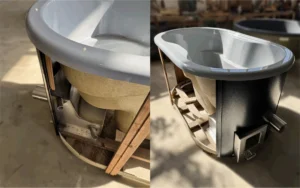 An integrated FLAT wood-fired heater installed beneath the insert of a Maudis Ofuro hot tub.
Ofuro is a compact two-person hot tub whose insert does not have the conventional raised area for a standard integrated heater. It can therefore be configured with an external heater, while the FLAT heater makes it possible to integrate wood-fired heating inside the tub. This means the compact Ofuro does not need a separate stove standing beside it when the FLAT configuration is selected. FLAT does not make every insert universal, however. Compatibility still has to be checked for the exact model and configuration.
| Hot tub model | Integrated heater | FLAT heater | External heater | Electric heating | Hybrid heating | Key notes |
|---|---|---|---|---|---|---|
| Round Ø200 | Regular option | Optional upgrade | Available | Optional upgrade | Optional upgrade | FLAT heater availability depends on the selected hot tub model. |
| Round XL Ø225 | Regular option | Optional upgrade | Available | Optional upgrade | Optional upgrade | XL external heater instead of regular size external heater |
| Quadro | Regular option | — | — | Optional upgrade | Optional upgrade | Compatibility depends on the selected insert |
| Quadro Lounge | Regular option | — | — | Optional upgrade | Optional upgrade | Hybrid heating combines an integrated heater with electric heating. |
| Ofuro | — | Optional upgrade | Regular option | Optional upgrade | Optional upgrade | Electric heating can be combined with the FLAT heater. |
Why the hot tub insert matters
The insert is one of the most important details to consider when comparing hot tubs, even though much of its design is hidden behind the exterior cladding. It determines more than the shape and appearance of the bathing area. Its geometry affects seating comfort, water volume, heater compatibility and the space available for water treatment and SPA equipment.
A well-shaped insert allows the body to sit deeper in the water while supporting a naturally reclined position. This is more comfortable than older straight-sided designs, where users often have to sit upright against a nearly vertical wall. Molded seats and enclosed areas beneath the benches can also reduce the amount of water required compared with a straight-sided tub of a similar external size. A lower water volume means the tub can be filled and heated more quickly and requires less water for each refill.
The insert can affect:
- whether a conventional integrated heater is possible;
- whether an external or FLAT heater is required;
- how much internal space remains;
- where the skimmer can be positioned;
- where SPA equipment can be installed;
- where water connections can be routed;
- how much technical space is required outside the tub;
- whether the hot tub can be integrated into a terrace.
This is why two hot tubs that look similar from the outside can have very different heating options.
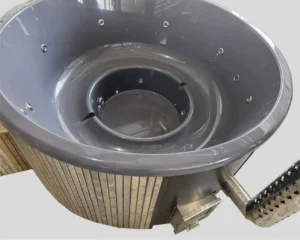
An integrated FLAT wood-fired heater installed in a hot tub with an insert originally designed for an external heater. Unlike a conventional integrated heater, the horizontal FLAT heater does not require a specially molded raised seating section above it. This allows selected inserts without this raised section to be configured with an integrated FLAT wood-fired heater, rather than placing the heater beside the hot tub.
How insert geometry affects water volume and heating time
Moulded seating and enclosed spaces beneath the benches can significantly reduce the internal water volume compared with straight-sided wooden or polypropylene tubs of a similar external size. For example, selected Maudis fiberglass outdoor hot tubs (integrated) hold approximately 1,100–1,200 litres of water, while a conventional 180 cm straight-sided wooden or polypropylene tub may require approximately 1,900–2,200 litres. The exact volume depends on the model, insert geometry, selected equipment and actual filling level.
Water volume is directly connected to heating time. An integrated or external wood-fired heater, as well as a Gecko electric system, must heat the full volume of water inside the tub. With comparable starting temperatures and outdoor conditions, a lower water volume generally requires less time and energy to reach the desired bathing temperature.
However, water volume alone does not determine heating time. It also depends on how effectively heat is generated, retained and distributed throughout the water. The main factors include:
- the selected heating system and the heater’s power and condition;
- the starting water temperature and outdoor conditions;
- the hot tub’s insulation, use of the insulated cover and water circulation.
The heating system also changes how the temperature is managed. A wood-fired heater heats the water during an actively supervised firing cycle, while a Gecko electric system can heat the water gradually and maintain the selected temperature automatically. In a hybrid configuration, wood-fired heating and electric temperature maintenance can be combined where the selected model supports both systems.
This means the insert should not be evaluated only by its external dimensions or number of seats. Its internal water volume directly affects how much water the selected heating system needs to heat and, consequently, the time and resources required to prepare the hot tub for use.
Skimmer and Gecko control integration
The insert also determines whether and where certain components can be integrated. A skimmer can be selected for Maudis Quadro SPA Lounge inserts, with its position coordinated with the insert geometry and water level.
The Gecko control panel is integrated into the upper edge of compatible inserts, allowing the user to control the hot tub directly from the bathing area. Its position and compatibility are determined by the selected insert and complete hot tub configuration.
What does electric heating change?
In selected hot tub configurations, Maudis uses the Gecko in.ye-V5 electric heating and control system together with the integrated in.k1000+ touchscreen. From the owner’s perspective, the main difference is not simply the energy source. It is the way the hot tub is prepared and used. Instead of lighting a fire and supervising the heating process, the user can set the required water temperature and allow the system to heat and maintain it automatically.
With the electric system, the user can:
- prepare the hot tub without lighting or tending a fire;
- maintain the selected temperature automatically;
- use electric heating independently in a hybrid configuration.
In a fully electric hot tub, heating can be scheduled in advance without continuous supervision. This is particularly convenient for regular use, as the system can maintain the selected temperature between planned bathing sessions instead of allowing the water to cool completely and reheating it from cold each time. The actual heating time depends on the water volume, starting temperature, outdoor conditions, insulation and use of the insulated cover.
In a hybrid configuration, the two heating methods serve different purposes. The wood-fired heater can bring cold water to bathing temperature more quickly, while the electric system can then take over and maintain the selected temperature automatically. This combines the heating performance and atmosphere of firewood with the convenience and precise control of an electric system.
What is a hybrid hot tub?
A hybrid hot tub gives you the freedom to choose how the water is heated depending on how and when you plan to use it. It combines a wood-fired heater with the Gecko electric heating and control system, bringing traditional wood heating and automatic temperature control into one configuration.
The two systems serve different purposes. The wood-fired heater can be used when you want to heat the water actively and more quickly while enjoying the traditional fire-heating process. The electric system can then maintain the selected temperature without requiring someone to continue feeding and supervising the fire.
The two heating systems do not have to operate simultaneously. A particularly practical routine is to use the wood-fired heater to bring the water to bathing temperature and then allow the electric system to maintain it afterwards. The hybrid configuration therefore makes most sense for owners who want both the experience of heating with wood and the convenience of thermostatic temperature control.
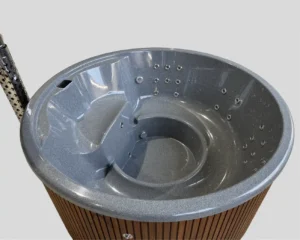
This hot tub features a hybrid heating configuration that combines an integrated wood-fired heater with a Gecko electric heating and control system. The wood-fired heater is installed beneath the raised seating section of the specially moulded insert, keeping it within the hot tub structure. It can be used to heat cold water actively, while the electric system provides automatic temperature control and can maintain the selected temperature afterwards.
A real Maudis example: QUADRO SPA LOUNGE
The QUADRO SPA LOUNGE is a good example of how several systems can be combined in one configuration. It can combine:
- Gecko in.ye-V5 electric heating;
- an integrated AISI 304 wood-fired heater;
- an integrated skimmer;
- SPA systems: hydromassage, air bubbles, led lights
- a fibreglass insert with a reclining lounge seat;
- a water capacity of approximately 1,600 litres.
The skimmer in this configuration is related to the Lounge insert design, not simply to the hot tub’s hybrid heating. A skimmer is not automatically included with every electric or hybrid hot tub. The QUADRO SPA LOUNGE model is configured with electric heating, hydromassage, air bubbles and lighting systems. The same model can also be configured with hybrid heating by combining the electric system with an integrated wood-fired heater. This shows why the heating, filtration and SPA equipment should be planned as one complete configuration rather than selected independently.
Which heating system is better for everyday use?
The best heating system is the one that fits the way you plan to use your hot tub. The main question is whether you prefer to prepare the water for individual bathing sessions, keep it at a controlled temperature for more frequent use, or combine both approaches. Your choice must also be compatible with the selected insert, available technical space and infrastructure at the installation site.
Choose wood-fired heating if:
- you use the hot tub mainly for planned bathing sessions;
- you enjoy the process of making a fire;
- you do not need the water to remain at an exact temperature between sessions;
- you prefer a heating system that does not depend on an electrical heating element;
- you have enough space for the selected heater configuration.
Choose electric heating if:
- you use the hot tub frequently;
- you plan to keep the water between sessions and choose an OsmoGuard insert;
- you want controlled temperature maintenance;
- you want to programme heating;
- you do not want to prepare and manage firewood;
- your property has the required electrical infrastructure.
Consider hybrid heating if:
- you want both wood-fired heating and electric temperature control;
- the hot tub will be used frequently;
- you want to heat the water with wood and then maintain it electrically;
- you plan to keep the water warm between bathing sessions;
- the selected hot tub model supports the complete configuration.
The decision should therefore be based not only on the preferred energy source, but also on how often the hot tub will be used, how much involvement you want in the heating process, the insert design, local climate, available space and the technical infrastructure of the property.
If you choose wood-fired heating: AISI 304 or AISI 316?
Once you have decided that wood-fired heating is suitable for your hot tub, there is one more technical choice to consider: the stainless-steel grade used for the heater. Maudis wood-fired heaters are made from AISI 304 stainless steel as standard, while selected integrated and external heater versions can also be ordered in AISI 316.
AISI 316 contains molybdenum, which gives it greater resistance to chloride-induced pitting and crevice corrosion. The two versions can look almost identical, but the main difference lies in the material and its resistance to corrosion.
AISI 316 should be viewed as a higher-resistance material option, not as permission to change the water-care requirements. It does not make the heater completely corrosion-proof or suitable for seawater and aggressive water chemistry. Maudis warranty conditions do not cover damage caused by seawater or aggressive chemicals.
What about water care and winter use?
The heating system affects your routine, but it does not replace water-care requirements. Gecko provides heating, circulation and equipment control. It is not automatically a filtration system. In configurations such as QUADRO SPA LOUNGE, a separate integrated skimmer can be included because of the specific Lounge insert design. The amount of time water can remain in the hot tub also depends on the insert, water-care system and treatment method. Rather than repeating those details here, see our guide Why a Fiberglass Hot Tub Is Not Like a Swimming Pool? for a more detailed explanation of water storage, OsmoGuard™ and water chemistry.
Winter use is also configuration-dependent. A correctly powered and operating Gecko system can support winter use. If the system is switched off while freezing temperatures are possible, the hot tub, heater and connected water lines must be fully drained. For detailed winter preparation, see How to Prepare Your Outdoor Hot Tub for Winter.
What should you plan before installing the hot tub?
The heating system should be selected before the hot tub is installed and before the surrounding area is completed. This includes timber decking, a paved or concrete terrace, steps, access paths, privacy screens, fences, landscaping and any structure built around the hot tub. The selected heater may require additional space space for the chimney, water connections, electrical equipment, firewood loading and future maintenance. Planning these elements in advance helps ensure that all technical components remain safely accessible and are not permanently enclosed by decking or other structures.
For a wood-fired configuration. Plan the heater position, chimney route, water connections and required safety distances. There must also be safe and convenient access for loading firewood, tending the fire and carrying out future maintenance.
For an electric or hybrid configuration. Confirm that the property has suitable electrical infrastructure and arrange for the system to be connected by a qualified professional. Allow sufficient space and service access for the selected electrical and water-circulation equipment.
If the hot tub is integrated into a terrace, the heater, water connections, drainage and technical equipment must remain accessible. Decking and other surrounding structures should not prevent future inspection, maintenance or repair.
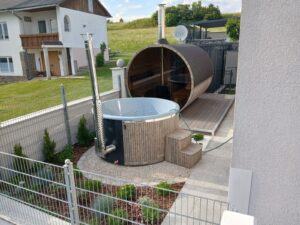
Maudis hot tub with a 3D Granite insert and an integrated wood-fired heater, installed on a prepared level base with access to the firebox, chimney and water connections.
Final checklist: which hot tub heating system should you choose?
Before ordering, ask yourself:
1. How often will I use the hot tub?
2. Will I drain the water after every bathing session?
3. Do I prefer lighting and managing a fire or setting the temperature on a control panel?
4. Does the selected insert allow the heater I want?
5. Is there enough space beside the hot tub for an external heater?
6. Is the required electrical infrastructure available?
7. Do I need wood-fired, electric or hybrid heating?
The best hot tub is not necessarily the one with the most equipment. It is the one where the insert, heating system, technical equipment and your actual usage pattern work together.
At Maudis, we recommend choosing the complete configuration first and only then finalising the installation and surrounding space.