By the time most people are ready to buy a sauna, they already know quite a lot: how much space they have, whether they want a separate entrance or changing area, sometimes even which heater they prefer. What often remains harder to decide is the shape. Barrel or Cube? And once you look beyond the obvious difference in appearance, the choice becomes less straightforward than it first seems.
We build both Barrel and Cube saunas ourselves, and over the years that has meant thousands of saunas in different sizes, layouts, and configurations, from private gardens and backyards to glamping and camping sites and rental properties. That experience has taught us that the shape is only the beginning. The way a sauna heats, how it fits into its surroundings, how it handles weather, how it is built, and how its individual details work together all influence the final result. That is what this comparison looks at: not just how Barrel and Cube saunas differ on paper, but what those differences actually mean when choosing one for your space.
Barrel vs Cube sauna at a glance
At first glance, the difference between a Barrel sauna and a Cube sauna seems obvious: one is rounded, and straight architectural lines define the other. But when it comes to the actual sauna experience, the gap is much smaller than the shapes might suggest. Both can be designed for year-round outdoor use, equipped with the same type of heater, and configured to suit how you want to use your sauna.
With Maudis, choosing the shape is only the starting point. Both Barrel and Cube saunas can be tailored in size and configuration, with options including wood species, wall construction, window placement, bench designs, and exterior finishes. This means you are not simply choosing between two fixed designs. You are choosing a form, then shaping the details to suit your space, your preferences, and how you want to use your outdoor sauna.
The table below provides a quick overview of the key differences and configuration options available for the two shapes. We then take a closer look at what these options mean in practice, and how much flexibility you have when configuring a Maudis Barrel or Cube sauna.
*From 4 m, Cube saunas are available in a Cube Combi configuration, combining the sauna with a covered outdoor area designed to accommodate a hot tub. The hot tub size that can be accommodated depends on the size of the Combi area. Hot tub is not included.
**Side glazing is available on selected Cube models and configurations, particularly larger models where windows can be added to the sauna room, relaxation room, or both.
How much can you customise the size and layout?
Although Barrel sauna and Cube sauna have very different shapes, they are built around the same basic sizing principle: the overall sauna length can be adapted to the space available, from compact 2 m models up to 5.4 m. The standard Maudis model range is centred around 2, 3, 4 and 5 m lengths, while 50 cm extensions allow the overall length to be adjusted between the main model sizes. The 5.4 m configuration is the maximum length available in the current range.
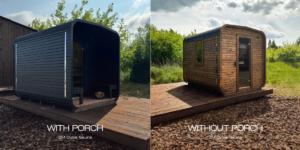
The same 3 m Cube Sauna footprint can be configured differently, depending on how you want to use the available length.
The important part is that adding length does not simply mean making the sauna room itself longer. Our standard layouts are based on a 2 m sauna room. This gives enough continuous space for a comfortable four-person family sauna while keeping the room compact and efficient. It also provides enough length for an adult to lie down comfortably, rather than making the sauna feel unnecessarily tight. The remaining length can then be used to create an entrance or relaxation area, depending on the configuration.

A compact 2 m Barrel keeps the full length for the sauna room, while from 3 m the layout can include a covered front porch.
From 3 m onwards, both Barrel and Cube can be configured with either a front porch, which we refer to as a terrace, or a more enclosed relaxation room. The porch is a covered outdoor entrance area with side walls, a roof and two outdoor benches, while the relaxation room creates a separate enclosed space between the outdoors and the sauna. This makes the additional length useful in a very different way: it can provide somewhere to leave towels and clothing, or simply a place to cool down and relax between sauna sessions.
On larger models, the internal division can be adjusted rather than following one fixed layout. For example, a 4 m or 5 m sauna does not necessarily have to use the standard 2 m sauna room with all remaining space assigned to the entrance area. The internal wall can be moved to create a longer sauna room and a smaller relaxation area, or the opposite, depending on how the sauna will actually be used. The Maudis price list specifically lists room-size adjustment by moving the internal wall as an available adjustment.
There are also a few differences that are specific to the Cube sauna collection. Cube Wide is a dedicated 4 m model with a wider configuration: its exterior length is 4 m, but the layout is turned across the building rather than following the usual lengthwise arrangement. This creates a different relationship between the sauna room, benches, entrance and glazing without simply adding more length.
Cube Combi takes the idea of using the available length even further. Available in 4 m, 5 m and 5.4 m configurations, it combines a 2 m sauna room with a semi-enclosed, roofed outdoor area. The hot tub is not included in the sauna price, but the covered area is designed to accommodate one. Importantly, the capacity depends on the model: the 4 m Cube Combi accommodates an Ofuro hot tub for two, while the 5 m configuration can accommodate a hot tub approximately 2 m in diameter. There is currently no equivalent Barrel configuration in the Maudis range.
This means that the choice between Barrel Sauna and Cube Sauna is not simply a choice between two shapes. Both can be adapted to the available space, but Cube offers a few additional ways of using that space — particularly through Cube Wide and Cube Combi.
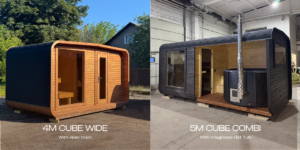
Two Cube configurations that use the available space differently: one through a wider interior layout, the other by extending the sauna experience outdoors.
What wood and wall construction options are available?
When choosing between a Barrel sauna and a Cube sauna, shape is only one part of the configuration. Both collections offer a choice of wood and wall construction, allowing you to decide not only how your outdoor sauna looks, but also how its walls are built and protected.
Spruce or thermowood?
Both Barrel sauna and Cube sauna are available in spruce or thermowood. Spruce is our standard wood option, while Thermowood can be selected as an upgrade, regardless of which wall construction you choose.
With a single-wall sauna, the wall can be made from either spruce or thermowood. The same choice is available with Double-wall: Spruce is the standard option for both the log wall and exterior W-profile cladding, while thermowood can be selected instead if you prefer to carry the thermowood finish throughout the sauna.
Single-wall or double-wall?
The standard single-wall construction uses a 42 mm solid log wall, which forms both the structure and the exterior of the sauna. For those looking for additional protection from outdoor conditions, both Barrel sauna and Cube sauna can be upgraded to Double-wall with waterproofing.
Double-wall builds on the same 42 mm log wall by adding a waterproofing layer and exterior W-profile wall cladding. This creates an additional protective barrier against moisture and changing outdoor conditions, while also giving the sauna a different exterior finish.
The choice between the two is therefore not simply about appearance. Single-wall keeps the original solid timber construction exposed, while Double-wall adds another protected layer around it. Both constructions are available in spruce or thermowood, so the wood and wall construction can be selected separately to suit the sauna you want.
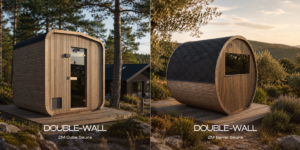
The Double-wall option adds exterior W-profile cladding over the original sauna wall, while preserving the characteristic shape of both Cube and Barrel sauna.
Outdoor sauna interior: how shape affects layout and design
The difference between a Barrel sauna and a Cube sauna becomes particularly noticeable once you start planning the interior. The curved shape of a Barrel naturally defines where benches and windows can be placed, while the straighter walls and greater vertical space of a Cube allow more flexibility in both seating layouts and glazing. These choices are closely connected: where you sit affects the view, bench height changes the heat you experience, and the amount of glazing influences both the atmosphere inside and the sauna’s heating requirements.
So rather than looking at benches, windows and heating as separate features, it is more useful to see how they work together within each sauna shape.
Outdoor sauna windows: how glazing options differ between Barrel and Cube
Windows are one of the areas where the difference between Barrel Sauna and Cube Sauna becomes more noticeable. Both can be kept relatively enclosed or opened up with panoramic glazing, but the shape of the sauna determines where that glass can be placed and how far the configuration can go.
With a Barrel Sauna, window placement follows the geometry of the barrel itself. The main glazing areas are the two end walls: windows can be added to the front wall, on either side of the entrance door, and to the rear wall. The rear wall is also where the larger panoramic options come into play, including Half-moon and Full-moon windows, allowing the end of the sauna to open towards the garden, backyard or surrounding landscape.
A Cube Sauna gives you more freedom with window placement. In addition to the front and rear walls, glazing can also be added to the side walls. This becomes particularly useful on larger Cube models with a relaxation room: windows can be planned not only around the sauna benches and the view from inside the hot room, but also in the relaxation area. On selected layouts, especially 4M Cube Wide, the larger wall surfaces also make significantly larger side glazing possible.
The Maudis window range includes several rectangular window sizes, from compact 30 × 94 cm windows up to 120 × 175 cm, as well as Bee-eye and Full Bee-eye glazing and a large 195 × 185 cm window option. Depending on the size, the windows are available with single or double-glazed tinted glass.
For both Barrel and Cube, panoramic glazing is therefore less about simply choosing the largest window available and more about deciding where you want the view to be when you are actually using the sauna. A rear panoramic window works naturally with benches facing along the sauna, while side glazing can completely change the relationship between a Cube interior and its surroundings. This is one of the reasons we recommend considering the window configuration together with the bench layout rather than treating the two as separate choices.
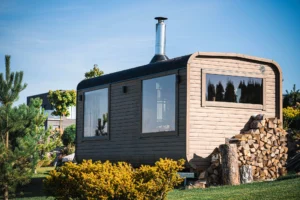
Cube sauna allows windows to be positioned along the side wall as well as the front and rear, giving more flexibility when planning glazing around the view.
Can sauna windows provide ventilation and privacy?
For additional ventilation, Maudis offers opening windows in several sizes: 30 × 40 cm, 40 × 60 cm and 40 × 107 cm. They can be used as smaller standalone windows, but are also a practical addition alongside larger fixed or panoramic glazing. This way, you do not have to choose between an open view and an opening window: the larger glazing can frame the landscape, while a smaller opening window gives you an easy way to increase airflow and air out the sauna when needed. Opening windows are also available with double-glazed tinted glass.
For more privacy, selected glazing can be specified with a mirror finish, reducing visibility into the sauna from outside while still keeping the benefits of larger glazing. It also changes how the sauna sits in its surroundings: rather than appearing as a dark glass surface, the window reflects the landscape, sky and changing light around it. This has become a particularly popular design approach for outdoor saunas placed in scenic locations, giving panoramic glazing a more contemporary architectural character without changing the sauna itself.
Do panoramic windows change the sauna construction?
With the largest glazing configurations, there is one more detail to consider. Steel bands are not a standard structural requirement for Maudis Barrel or Cube saunas, but certain large panoramic window configurations require additional reinforcement. When a Half-moon or Full-moon window is added to the rear wall of a Barrel or Cube Sauna, the construction requires a minimum of two steel bands, with the chimney passing through the roof. The same reinforcement is needed for Barrel Saunas with a Full Bee-eye window in the front wall.
This is particularly relevant when choosing Full-moon or other full-wall panoramic glazing: the window is not simply an aesthetic add-on, because replacing a substantial part of the timber end wall with glass can also affect the required construction details.
And, as discussed earlier, the amount of glazing should also be considered when selecting the heater, as larger glazed areas affect the sauna’s heating requirements. We look at this in more detail below. So the best window configuration is not necessarily the one with the most glass, it is the one that works with the view, bench layout, sauna size and the way you plan to use the space.
Sauna bench layout: how shape changes the seating options
The difference between Barrel and Cube becomes just as noticeable when planning the benches. In a Barrel Sauna, the curved walls naturally lead to a symmetrical arrangement with two single-level linear benches along opposite sides. It is a simple and space-efficient layout that keeps the centre of the sauna open and everyone seated at approximately the same height.
Cube sauna gives you more freedom to work with the available space. In 3 m models, a single-level arrangement with two linear benches along opposite walls is a common choice, while the wider 4M Cube Wide is often configured with two-level benches along one wall. These are not fixed layouts, however. Depending on the model, available space, window placement and how you want to use the sauna, the benches can also be arranged in linear, L- or U-shaped configurations.
Bench design can be customised as well. Both Barrel and Cube saunas are available with floating or enclosed benches, so the final interior can lean towards a lighter, more contemporary look or a more traditional enclosed construction.
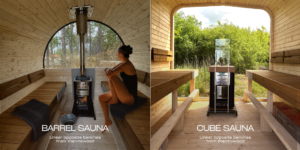
Both Barrel and Cube saunas can use opposite linear benches, while the straighter Cube interior allows for additional seating layouts and bench levels. Here, a Half-moon window in the Barrel sauna and a Full-moon window in the Cube sauna show how panoramic glazing works with each interior shape.
Barrel vs Cube Sauna heating: how heater choice affects performance
The shape of an outdoor sauna affects more than how it looks. The curved walls and ceiling of a Barrel Sauna and the vertical walls and flat ceiling of a Cube Sauna create different interior volumes and different ways for heat to move through the sauna. But shape is only one part of the picture. Heater type and power, bench height, window area, door position and the presence of an entrance or relaxation area all influence how efficiently a sauna heats and how warm it feels when you are sitting inside.
In every sauna, warm air naturally rises, creating a temperature gradient from the floor towards the ceiling. This is why the height of the benches matters so much: where you sit determines which part of that heat gradient you experience. The same principle applies to both Barrel and Cube saunas.
Barrel Sauna: a compact, single-level heat zone
The curved form of a Barrel Sauna creates a continuous rounded ceiling and a compact interior volume. As the air heated by the sauna heater rises, it moves through this curved space rather than accumulating beneath a conventional flat ceiling.
The other important factor is the bench layout. Maudis Barrel Saunas use a single-level linear bench arrangement. This means that bathers sit within a relatively similar vertical heat zone rather than choosing between significantly different upper and lower bench temperatures.
That does not mean that the Barrel Sauna has no temperature gradient. The air higher in the sauna will still be warmer than the air closer to the floor. The difference is that the single-level bench layout keeps the main bathing area at a similar height. For many people, this creates a straightforward sauna experience: one continuous seating level, a compact volume and the characteristic curved interior of the Barrel Sauna.
Cube Sauna: more vertical space and more choice in heat levels
The Cube sauna has vertical walls and a flat ceiling, giving the interior a different volume and a more pronounced vertical temperature gradient. Warm air rises and collects in the upper part of the sauna, while the air closer to the floor remains cooler.
This becomes particularly useful when the Cube is configured with two-level benches. The upper bench places the bather higher in the warmer part of the sauna, while the lower bench provides a milder position. In this way, the bench layout itself gives bathers more choice over the intensity of the heat they experience. This is one of the practical differences between the two shapes. Barrel sauna keeps the main bathing area at one bench level, while Cube sauna can use its vertical space to create distinct heat levels.
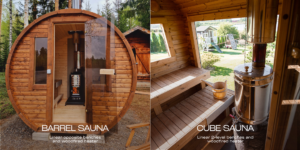
Both examples use a wood-fired heater. The Barrel Sauna keeps opposite benches at a single level, while the Cube Sauna uses two-level seating, allowing bathers to choose between different positions within the sauna’s natural heat gradient.
Windows, doors and entrance areas also affect heating
The size of the glazing is another factor that should not be overlooked. A large window can transform the feeling of an outdoor sauna by bringing in more natural light and opening the view to the surroundings, but glass also changes the thermal requirements of the sauna. Larger window surfaces generally increase the heat load that the heater needs to compensate for, which is why window area is taken into account when determining the required heater power.
The way you enter the sauna matters as well. A sauna with the door opening directly outdoors will experience a greater exchange of warm and cold air whenever the door is opened than a configuration where the sauna room is separated from the outdoors by a relaxation room. An enclosed relaxation room acts as an intermediate space between the sauna and outside, while a porch provides a covered outdoor entrance but does not create the same enclosed buffer.
This does not mean that a sauna with a direct outdoor entrance cannot heat efficiently. It simply means that more heat can be lost each time the sauna door is opened directly to cold outdoor air. Keeping the sauna door closed as much as possible during heating and bathing helps retain the heat inside.
This is also why the overall configuration matters when choosing the heater. A 4 m sauna with large glazing and a different internal layout is not thermally identical to a smaller, more enclosed sauna, even if the two use the same heater type. The required heater power is determined by the sauna volume together with factors such as window surfaces and construction.
Does electric or wood-fired heating change the way the sauna heats?
Both electric and wood-fired heaters heat the sauna through the same fundamental processes: heating the air, sauna surfaces and stones, with warm air rising through the room. The difference is in how the heat is generated and delivered.
An electric heater provides controlled, consistent heat from its heating elements and stones. A wood-fired heater adds direct radiant heat from the stove and combustion chamber, while its heated stones contribute to the sauna’s löyly. The exact heat experience therefore depends on the particular heater, its power and stone capacity rather than simply on whether it is electric or wood-fired.
For a Barrel sauna vs Cube sauna comparison, it would therefore be misleading to say that one shape is inherently more efficient with an electric heater and the other with a wood-fired heater. The more meaningful difference is how the chosen heater works together with the sauna volume, bench height, glazing, ventilation and overall configuration.
The important point is that sauna performance is not determined by shape alone. The shape establishes the interior geometry, but the final heat experience comes from the combination of the sauna volume, heater, bench layout, glazing, ventilation and entrance configuration.
Choosing between a Barrel and Cube sauna: what matters most?
Choose a Cube sauna if you are looking for a more contemporary addition to a modern home, garden or backyard, or if you want greater freedom in how the sauna is configured inside. Its straighter walls allow more flexibility with bench layouts, including two-level seating, while the wider choice of window positions makes it easier to plan the interior around a particular view. Cube also gives you access to configurations that simply do not exist in the Barrel collection, such as 4M Cube Wide and Cube Combi, where the sauna can be combined with a covered hot tub area. If panoramic glazing, more flexible interior planning and a clean, contemporary exterior are high on your list, Cube will usually give you more room to work with.
A Barrel sauna makes more sense if you are drawn to the characteristic rounded sauna form and want a simpler, more compact layout that feels at home in both a garden and a more natural setting. Its curved interior naturally works with two linear, single-level benches, creating a straightforward bathing space where everyone sits within a similar heat zone. Window placement is more defined than in Cube, but there is still plenty of scope to open the sauna towards its surroundings with Half-moon or Full-moon panoramic glazing, as well as front glazing options. And Barrel does not necessarily have to look rustic: with Thermowood, exterior finishes and W-profile cladding, the same curved form can take on a much more contemporary character.
There is no better shape in absolute terms. Both Barrel and Cube can be customised in size, timber, wall construction, glazing and heater choice. The real difference is what each shape allows you to do with those choices: Barrel gives you a more defined, compact sauna concept, while Cube gives you more freedom to shape the architecture and interior around the way you want to use it.
Frequently Asked Questions about Barrel and Cube saunas
Is a Barrel sauna hotter than a Cube sauna?
Not necessarily. Both Barrel and Cube saunas can reach traditional sauna temperatures when the heater is correctly matched to the sauna. Their shape does, however, influence how that heat is experienced. A barrel has a compact, curved interior with single-level benches, so bathers sit within a similar heat zone. A Cube can be configured with two-level benches, allowing you to sit higher for more intense heat or lower for a milder experience. The actual heating performance also depends on the sauna volume, heater power, ventilation, glazing and entrance configuration, not simply whether the sauna is round or rectangular.
Do Barrel and Cube saunas need different heaters?
Not simply because of their shape. Both Barrel and Cube saunas can be equipped with wood-fired or electric heaters, but the correct heater should be selected according to the actual sauna configuration. The size and volume of the sauna room, glazing area, wall construction and other heat-loss surfaces all influence the required heater capacity. A sauna with extensive panoramic glazing, for example, may have different heating requirements from a more enclosed sauna of a similar size.
Which lasts longer, a Barrel Sauna or a Cube Sauna?
Neither shape is inherently more durable. The lifespan of an outdoor sauna depends much more on the timber, wall construction, weather protection and maintenance than on whether it is a Barrel or Cube. Both Maudis collections are available in spruce or thermowood and can also be configured with Double-wall with waterproofing for additional protection against moisture and changing outdoor conditions. If longevity is the priority, these construction choices are more important than choosing one sauna shape over the other.
Which is easier to maintain, a Barrel sauna or a Cube sauna?
The maintenance requirements are broadly similar because both are timber outdoor saunas exposed to the same weather conditions. The selected wood, exterior finish, glazing and wall construction will generally make a greater difference to maintenance than the sauna shape itself. A Barrel’s curved exterior naturally allows rain and snow to run off, while Cube has a separate roof construction designed to protect its straighter form. Larger panoramic windows in either model should also be kept clean and their seals and surrounding construction checked as part of normal sauna maintenance.
Is a Barrel or Cube Sauna better for a small backyard?
Do not choose by shape alone, choose by actual dimensions and layout. Both Maudis Barrel and Cube saunas start at 2 m in length, which provides enough room for a comfortable four-person family sauna and approximately 2 m long benches.
For a limited garden or backyard, the smallest model may be the obvious starting point, but available width, door position, the direction of the view and whether you want a porch or relaxation room can be just as important as length. From 3 m onwards, both collections offer additional layout possibilities, so measuring the available space against the actual model dimensions is more useful than assuming that Barrel or Cube will always be more compact.
Is a Cube Sauna better for a modern home?
If contemporary architecture is the priority, Cube Sauna will usually be the more natural choice. Its straighter lines, larger glazing possibilities and more flexible interior layouts work particularly well alongside modern homes and landscaped backyards. That does not mean a Barrel Sauna has to look rustic. Thermowood, W-profile exterior cladding, modern glazing and carefully selected exterior finishes can give the traditional rounded form a much more contemporary character.
Can both Barrel and Cube saunas have panoramic windows?
Yes, but Cube offers more flexibility in where the glazing can be placed. Barrel window options are concentrated on the front and rear walls, including Half-moon and Full-moon panoramic rear windows and front glazing configurations. Cube can also have front and rear glazing, but its straight side walls make side windows possible as well – particularly useful on larger models and layouts with a relaxation room. Both shapes can therefore create a very open connection with the garden or landscape, but Cube gives you more freedom to decide which direction the sauna opens towards visually.
Can Barrel and Cube Saunas be used all year round?
Yes. Both are outdoor saunas designed for year-round use, including winter. Colder outdoor temperatures can increase preheating time and heating demand, but the same basic principle applies to both shapes: the heater must be correctly matched to the sauna, and the sauna should be used and maintained according to its outdoor conditions.
If the sauna will be exposed to particularly demanding weather, the choice of timber and wall construction – including the available Double-wall with waterproofing option – becomes especially relevant.
Ready to find the right sauna for your backyard?
By now, you probably have a clearer idea of which sauna shape fits your space and the way you want to use it. Both Barrel sauna and Cube sauna can be adapted in size, wood, wall construction, windows, bench layout and heater choice, so choosing the shape is really the starting point for creating the right configuration.
Explore our Barrel sauna and Cube sauna collections to compare available models and configurations, or browse all outdoor saunas to see the full range. If you already have a particular size, layout or window configuration in mind, contact us and we can help you find the configuration that works for your space.