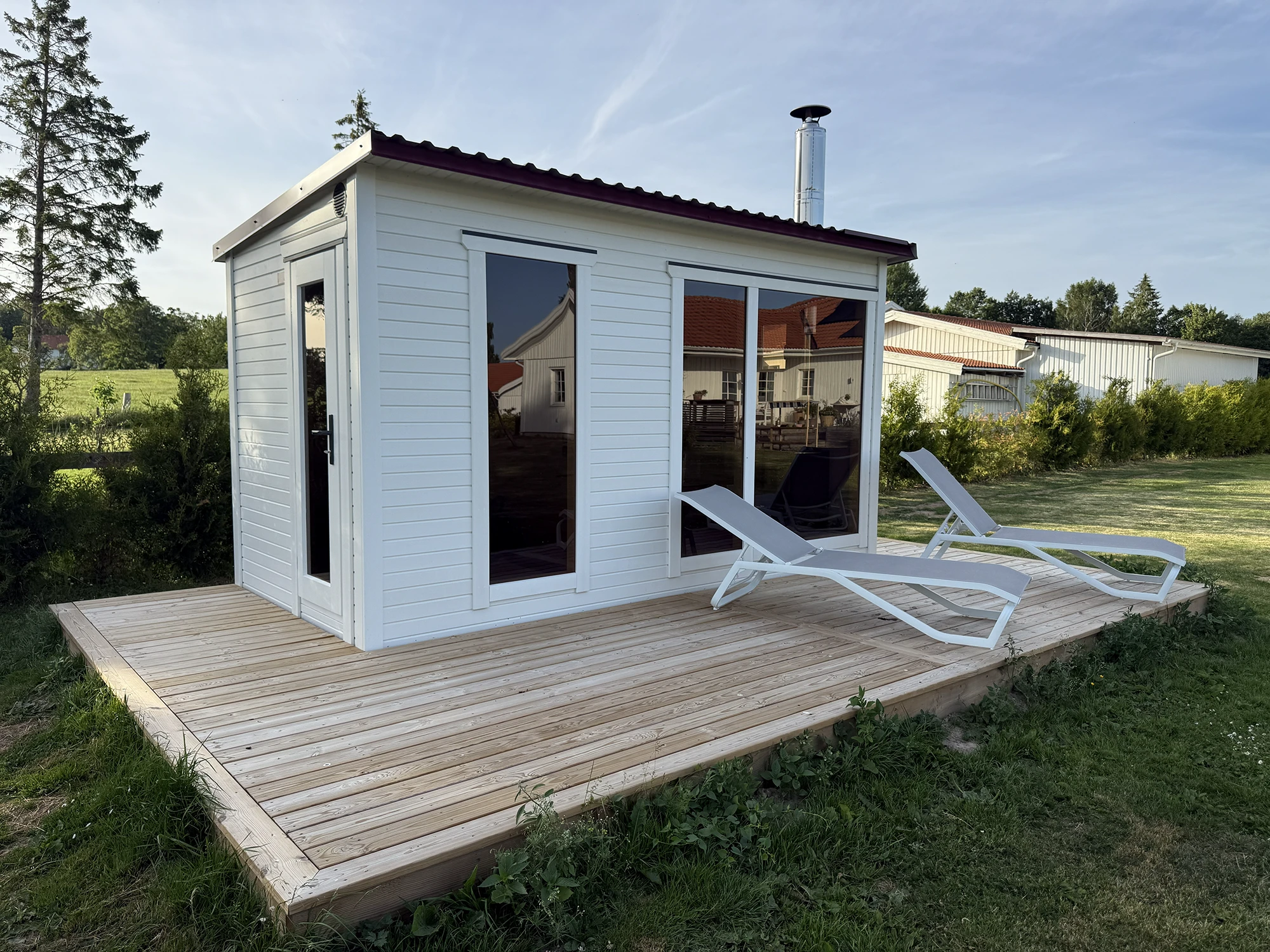
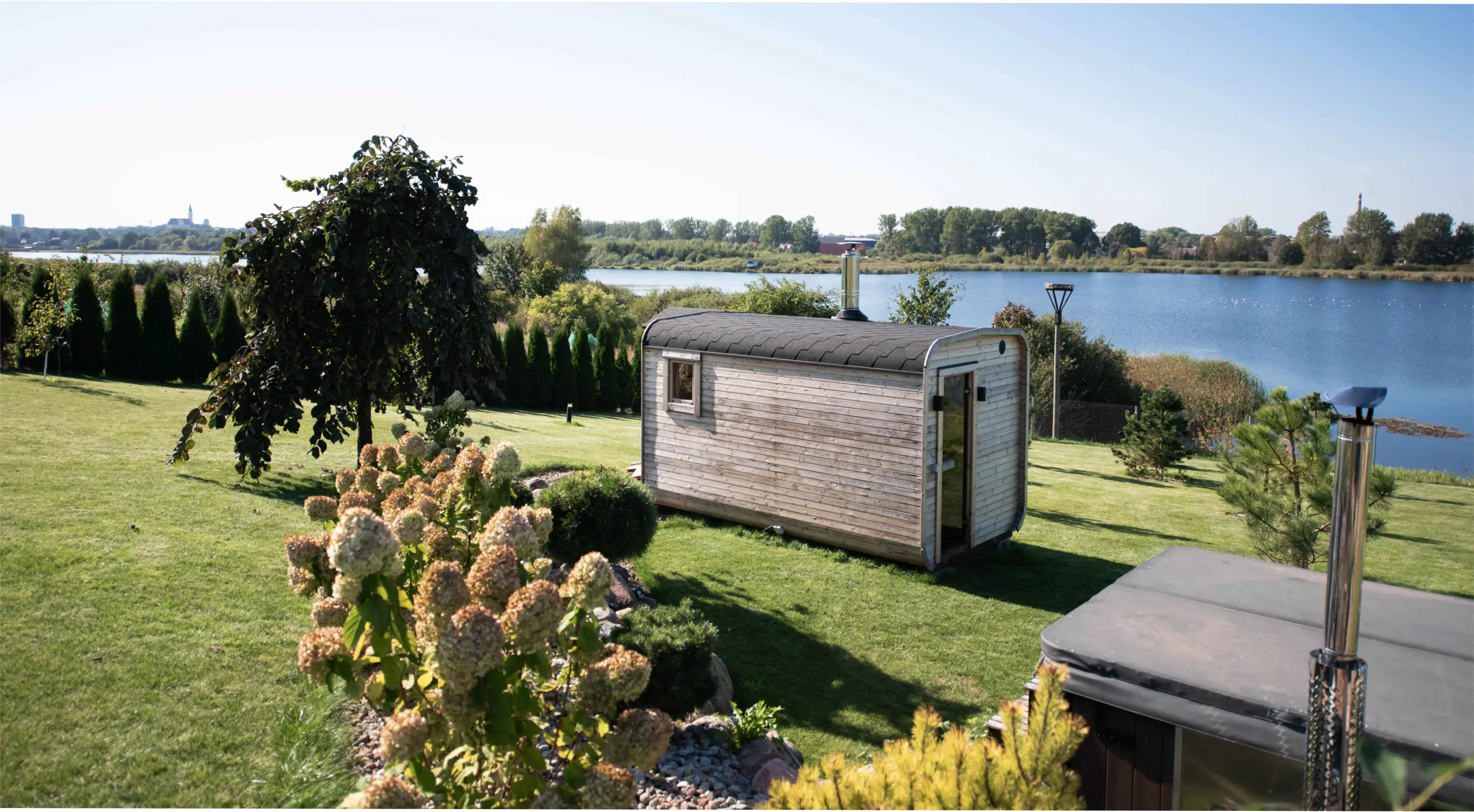
Two outdoor saunas of similar size may need different heaters. The difference can come down to the heated room volume, panoramic glazing, wall construction or the way the sauna is designed to be used.
Choosing between an electric and a wood-burning sauna heater is only the first step. You also need to consider the heater’s power, stone capacity, controls, ventilation and installation requirements. For a wood-burning heater, the position of the firebox and the chimney route can be just as important as its heating capacity.
This guide explains how to compare sauna heaters, calculate the heating requirement and choose a suitable configuration for your Maudis outdoor sauna.
1. Electric vs wood-burning sauna heaters: which should you choose?
Both electric and wood-burning heaters can provide an enjoyable sauna experience. The main difference is how you prepare, control and maintain the heat.
Electric sauna heaters: convenient everyday operation
Electric heaters are operated through built-in controls or a separate control panel. Depending on the model, Wi-Fi connectivity may also allow remote operation when the required safety features are installed. An electric heater can be a practical choice if you use your sauna frequently or prefer to start heating without preparing firewood and tending a fire.
However, the installation site must have the required electrical supply. The heater must be connected by a qualified electrician according to the manufacturer’s instructions.
Wood-burning sauna heaters: a traditional heating routine
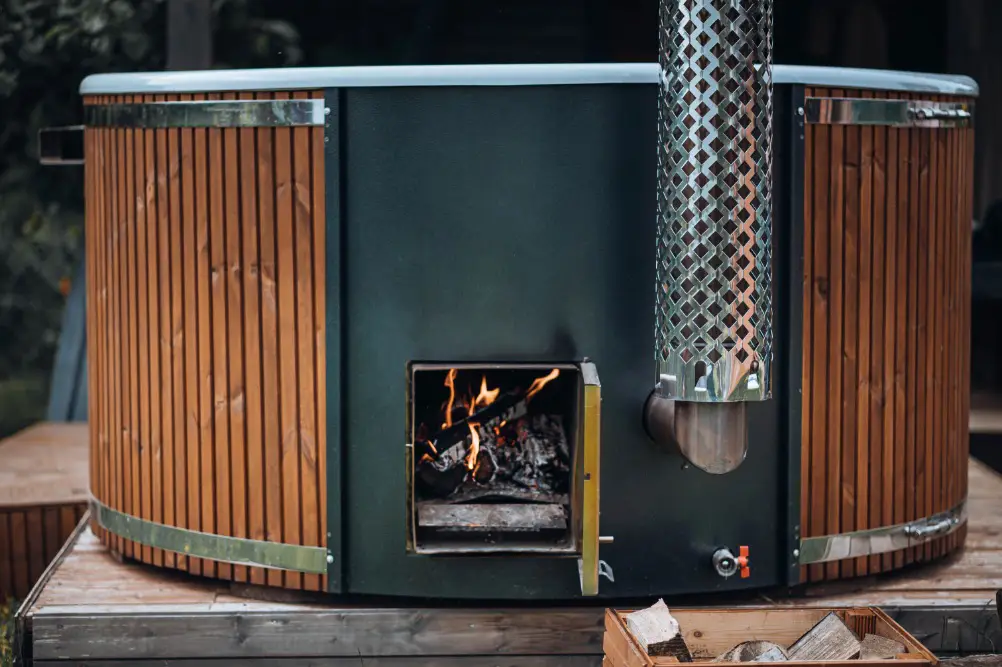
With a wood-burning heater, lighting the fire and adding firewood are part of the sauna experience. Many sauna enthusiasts enjoy this routine, along with the visible flames and atmosphere of a wood-fired stove. A wood-burning heater does not require electricity to generate heat, but it needs a correctly installed chimney, adequate combustion air and sufficient safety clearances. It also requires hands-on maintenance, including removing ash and checking the condition of the firebox and chimney system.
Electric or wood-burning: a quick way to decide
Neither option is automatically better. Start with how you expect to use your sauna and what the installation site allows. You can also read Harvia’s guide to choosing a wood-burning heater for further technical considerations.
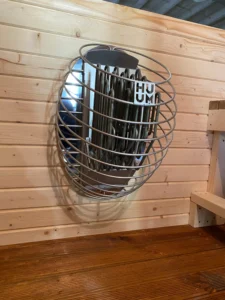
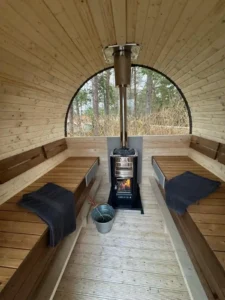
The electric HUUM DROP is operated from a control panel and needs a suitable electrical supply. With the wood-burning Harvia, you light and tend the fire by hand, and the chimney carries smoke out through the sauna roof.
2. How much power does your sauna heater need?
A sauna heater must be matched to the volume and construction of the heated sauna room. The overall dimensions of the building are not enough. For example, a 5-metre outdoor sauna with a separate relaxation room does not necessarily need a more powerful heater than a shorter sauna with a larger heated room.
Calculate the internal sauna volume
For a rectangular sauna room, measure the internal length, width, and height in meters.
Sauna room volume (m³) = length × width × height.
For example: 2.0 m × 2.0 m × 2.2 m = 8.8 m³
This gives you the starting volume for heater selection. The relaxation room, terrace or other unheated areas should not be included. For a curved or irregularly shaped sauna room, use the actual internal geometry or a calculated volume supplied for that sauna model rather than treating the entire space as rectangular.
How do panoramic windows affect heater sizing?
Large glass surfaces can increase the heating requirement because they do not provide the same insulation as a properly insulated sauna wall.
For example, Harvia’s official heater sizing guidance recommends adding the equivalent of 1.2 m³ to the calculated sauna volume for every square metre of glass, stone or similar non-insulated surface. Different manufacturers may use different adjustment methods.
Consider a theoretical sauna room with:
- Internal volume: 8.8 m³.
- Relevant non-insulated glass area: 2 m².
- Harvia adjustment: 2 × 1.2 m³ = 2.4 m³.
The resulting adjusted sauna volume is approximately 11.2 m³. This does not mean that the sauna physically contains 11.2 m³ of air. It is a calculation used to account for additional heating requirements. The next step is to compare the adjusted volume with the specific heater’s recommended minimum and maximum sauna room volume. The manufacturer’s additional sizing and installation requirements must also be considered. This is an illustrative calculation, not a heater recommendation for a particular Maudis sauna.
Practical tip: finalise your window configuration before selecting the heater. Adding panoramic glazing or changing the type of glass may affect the required heating capacity.
3. How does sauna construction affect heater selection?
Sauna heater selection depends not only on the heated room’s size but also on how the sauna is built. Its shape influences the internal air volume, while wall construction, insulation, and glazing affect heat loss. These differences matter most when comparing traditional Barrel and Cube saunas with insulated timber-frame models. Understanding how these features work together helps explain why saunas of similar external dimensions may have different heating requirements.
Barrel vs Cube saunas
The rounded shape of a Barrel sauna creates a different internal space from a rectangular Cube sauna. With no upper corners, a Barrel sauna generally has less air to heat than a Cube sauna of comparable dimensions. However, the shape alone does not determine the required heater output.
The actual size of the heated sauna room matters more than the overall length of the building. For example, a Barrel sauna may have a 2-metre sauna room, a longer 3-metre layout with a separate changing room, or a spacious 4-metre sauna room designed to accommodate more people. Larger heated spaces generally require more powerful heaters, regardless of the sauna’s shape.
Glazing configuration is another important factor. Maudis Barrel and Cube saunas can feature panoramic Half Moon or Full Moon windows, as well as other glazing options. The location of the glazing matters: a large window in the heated sauna room affects its heating requirements differently from a window positioned in a separate changing room. Therefore, both the glazed area and its location should be considered when selecting a heater.
Wall construction also influences heat loss. Maudis Barrel and Cube saunas are available in different construction configurations, including insulated options. An insulated sauna may have different heating requirements from a comparable single-wall model, so the actual wall construction should be considered alongside the heated room volume and glazing.
Ultimately, heater selection should be based on the specific sauna configuration rather than its external shape or dimensions alone. For a wider comparison of sauna designs and layouts, see the Maudis Outdoor Sauna Buying Guide.
What about insulated TAVO FRAME saunas?
Maudis TAVO FRAME saunas feature insulated timber-frame construction with PIR insulation in the walls, floor, and ceiling. The insulation helps reduce heat transfer through the building envelope.
Unlike Barrel and Cube saunas, where the heated room can vary considerably in size, the TAVO FRAME collection features a consistently sized sauna room in its standard configurations. The Comfort and Terrace models are available in three sizes (S, M, and L), with differences primarily in the changing room or terrace rather than the heated sauna space.
The sauna room also features fixed-size panoramic glazing measuring 185 × 195 cm. This makes the heated room dimensions and glazing area more consistent across the collection, even when the overall building size differs. However, insulation is only one part of the heating calculation. You must also consider the heated room volume, panoramic glazing, selected heater, and ventilation arrangement.
For TAVO FRAME, Maudis offers electric heater configurations starting from approximately 10 kW, including models such as the 10.5 kW HUUM HIVE Mini 11 and the 10.8 kW Harvia Cilindro PC110XE.
These examples reflect the Maudis configuration approach rather than a universal rule for insulated saunas. The selected heater must still suit the final sauna room and its calculated heating requirements.
4. Comparing electric sauna heaters: why kW is not the only difference
Two electric sauna heaters with the same rated power can differ significantly in construction, stone capacity, controls and installation requirements.
The Maudis range includes both compact wall-mounted heaters and larger designs with more exposed stones. Rather than comparing every available model, the following examples illustrate the differences worth considering.
Power ratings and stone capacities are based on the Maudis 2026 heater catalogue. The manufacturer’s recommended room-volume range, safety distances and controller requirements must be checked for each selected model.
For example, HUUM specifies a 10–16 m³ sauna room range for the HIVE Mini 11. This does not mean that the model is automatically suitable for every sauna whose measured internal volume falls within that range, particularly where extensive glazing or other heat-loss factors require adjustment.
Does stone capacity make a difference?
Yes. Sauna stones absorb and store heat, and their temperature and arrangement influence how the heater responds when water is poured onto them. A larger quantity of stones generally provides more thermal mass. This can affect how heat is stored and released and how steam is produced during bathing.
However, more stones do not automatically make one heater better than another. Heater design, airflow, heating power and stone arrangement also influence performance. A larger stone mass may also require more time to reach the intended bathing temperature.
For example, the Harvia Top Steel M90 and Cilindro PC90 are both rated at 9 kW, but their stone capacities differ considerably. This is worth considering when choosing between a compact heater and a design with a larger stone compartment. Always use the stone type, quantity and placement specified by the manufacturer. For more information, see HUUM’s guide to sauna stones and compatible heater models.
What about sauna heater controls?
Some electric heaters have integrated controls, while others require a separate control unit. Selected systems also provide Wi-Fi or app-based operation. For example, HUUM electric heaters in the Maudis range require a compatible controller, with local and Wi-Fi options available. Wi-Fi compatibility should not be confused with a complete remote-start installation. The controller, temperature sensors and any required door or heater safety devices must be compatible with the selected system. When comparing electric heaters, check the complete configuration rather than the heater body alone.

Modern controls make it easier to fit a traditional sauna session into your day. With the HUUM app and a compatible electric heater, you can set the temperature and schedule heating from your phone, so the sauna can be ready when you get home from work.
5. Wood-burning sauna heaters: internal or external firebox?
One of the most useful decisions when choosing a wood-burning heater is where you want to load the firewood. Maudis offers models with an internal firebox and models with an external-access firebox. The difference affects the sauna layout, installation and everyday operating routine.
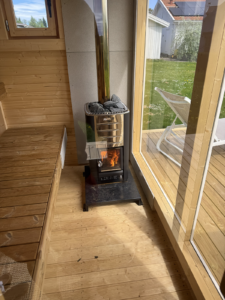
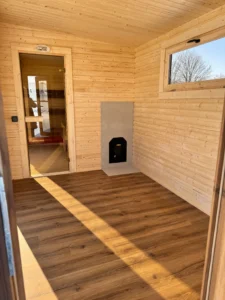
These two installations show where you can light and tend a wood-burning sauna heater. In the first, the firebox door opens into the sauna room. In the second, you add firewood from the adjoining changing room through a firebox door in the partition wall.
Internal firebox: loading wood inside the sauna
With a conventional internal firebox, firewood is loaded directly from the sauna room. The firebox door is inside the sauna, and models with glass doors allow the flames to be seen while bathing. This is a familiar choice for people who enjoy tending the fire as part of the sauna experience. However, space around the firebox must remain accessible, and firewood and ash are handled within the heated room.
External-access firebox: heating from the other side of the wall
With an external-access firebox, the main heater body and sauna stones remain inside the sauna while the firebox extends through a wall. Firewood can be loaded from an adjacent room or another designated access area, depending on the sauna layout. This separates the wood-loading and ash-removal routine from the bathing space and eliminates the need to approach the firebox door from inside the sauna.However, the design requires a compatible wall penetration, correct fire protection and appropriate safety clearances.
Internal vs external firebox: comparison
Maudis offers corresponding models such as the Harvia M3 and M3 SL, or Harvia Pro 20 and Pro 20 SL. The SL versions are designed for through-wall firebox access.
Important: An external-access firebox does not mean that the entire stove is installed outside. The heater and stones still heat the sauna room.
Why do wood-burning heaters have different stone capacities?
Wood-burning heaters also vary in their stone capacity. For example, the Maudis range includes the Harvia M3 with approximately 30 kg of stones, the Pro 20 with approximately 40 kg and larger stone-filled designs in the Harvia Legend series. A larger stone capacity affects thermal mass and the way the heater responds during sauna bathing, but it should not be considered independently of combustion performance, recommended room volume and heating routine. The best choice is not necessarily the stove with the largest stone compartment.
What does BImSchV2 mean?
If your outdoor sauna will be installed in Germany, you may encounter the designation BImSchV2 when comparing wood-burning heaters. This refers to Stage 2 emission requirements under Germany’s regulations for small combustion installations. These requirements limit pollutants, including carbon monoxide and particulate emissions.Selected Maudis heater options, such as the Harvia Linear 18 Compact, meet BImSchV Stage 2 requirements. However, compliance must be confirmed for the exact heater model, and local installation requirements must also be checked.
A heater suitable for one European market should not automatically be assumed to meet every requirement in another country.
6. Plan the electrical supply, chimney and ventilation before ordering
The heater and its installation requirements should be considered together with the sauna layout. It is much easier to plan these details before manufacturing than to make changes after the sauna has been delivered.
Electrical requirements
Maudis saunas include electrical preparation for standard lighting, but the lighting wiring is not the power connection for an electric sauna heater. Additional preparation for heater and sensor wiring can be arranged separately. The appropriate electrical supply must be provided, and the heater must be connected by a qualified electrician in accordance with the selected heater’s specifications and applicable local requirements. Before ordering, confirm the required electrical supply, control unit, connection arrangements and installation responsibilities. For more details about preparing a Maudis sauna for use, see the Maudis FAQ.
Wood-burning heater and chimney installation
A wood-burning heater requires a compatible chimney system and a safe route for the flue. Depending on the sauna configuration, the chimney may pass through the roof or, where specifically supported, through a wall. For Maudis Barrel and Cube configurations with Half Moon or Full Moon panoramic windows, the chimney must be routed through the roof. This makes it important to plan the windows, heater and chimney together. Maudis wood-burning heater packages can include the compatible chimney system and protective components. The final chimney assembly and installation must follow the supplied instructions and applicable local requirements.
Heater clearances and protective shields
Every heater has specified minimum distances from combustible surfaces, including timber walls and benches. Selected Harvia protective shields can reduce some required clearances when used with compatible heaters. They can be particularly useful in compact sauna layouts, but the shield must be approved for the heater model and installed according to its instructions. A protective shield does not eliminate the need to follow the manufacturer’s specified installation requirements. Fire safety requirements may vary from country to country, so check the rules that apply at your installation site before finalising your sauna configuration.
Why sauna ventilation matters
Ventilation supplies fresh air to the sauna and helps remove used air and moisture. For wood-burning heaters, adequate combustion air is also essential for safe and effective operation. Maudis currently applies a three-ventilation-opening approach in its TAVO FRAME Sauna configurations.
However, the position and purpose of each opening must still be suitable for the selected heater, ventilation method and sauna layout. Electric and wood-burning sauna ventilation arrangements can differ. For example, the position of the supply air opening depends on whether mechanical or gravity ventilation is used. For detailed recommendations, see Harvia’s official sauna ventilation guide.
An opening window can provide additional airflow when suitable for the sauna and outdoor conditions, particularly during drying after a session. It does not replace the required ventilation openings. Use the sauna’s designated ventilation openings and drying procedure. Open doors or windows for additional airflow only when recommended for your sauna and suitable for the outdoor conditions.
For more information about ventilation, drying and routine care, read the Maudis Outdoor Sauna Maintenance Guide.
7. Common mistakes when choosing a sauna heater
Even when the sauna design has already been chosen, a few common decisions can make heater selection unnecessarily complicated.
- Choosing by kW alone. A heater’s rated power is only one specification. Always check the recommended room-volume range, glazing adjustments, construction and installation requirements.
- Ignoring panoramic glazing. A large window may change the effective heating requirement. Finalise the glazing configuration before confirming the heater.
- Choosing the firebox arrangement too late. An external-access firebox affects wall construction and layout. Decide where the firewood will be loaded before finalising the sauna configuration.
- Assuming every electric heater includes Wi-Fi. Some systems require a separate controller and additional components for remote operation.
- Leaving site requirements until delivery. Confirm the electrical supply, chimney route, protective clearances and ventilation before ordering.
These checks can prevent unnecessary changes and help ensure the heater works with the sauna as a complete system.
8. Which sauna heater should you choose?
A suitable heater should match the sauna room, the way you intend to use it and the installation conditions at your property. If you prefer convenient, control-based operation, an electric heater may be the practical starting point. If you enjoy preparing and tending a fire, a wood-burning heater may better suit your routine. You can then choose whether firewood should be loaded from inside the sauna or through an external-access firebox. In either case, the final heater should be selected using the manufacturer’s sizing and installation specifications.
Your sauna heater checklist
- Heated sauna room volume: Use the actual internal dimensions, not the overall building size.
- Windows and construction: Account for glazing, insulation and other relevant surfaces.
- Heater specifications: Confirm the power, recommended room-volume range, stone capacity and controls.
- Installation requirements: Check electrical supply or chimney route, safety clearances and ventilation.
- Operating routine: Consider who will use, operate and maintain the heater.
Maudis can help review the selected sauna configuration and available heater options before the order is finalised. Contact the Maudis team to discuss your outdoor sauna project.
Frequently Asked Questions
Is a more powerful sauna heater always better?
No. A heater that is too powerful for the room may also be unsuitable. Choose a heater within the manufacturer’s recommended sauna volume range, taking construction and glazing into account.
Does a panoramic sauna window require a more powerful heater?
It can. A larger non-insulated glass area may increase the calculated heating requirement. Use the heater manufacturer’s adjustment method rather than choosing a higher kW rating without checking.
Which heater is better for a sauna with a relaxation room?
The relaxation room does not automatically increase the volume that needs to be heated. Calculate the heated sauna room separately. A relaxation room may also provide a suitable firebox-access location for certain through-wall wood-burning heater configurations.
Can I heat a sauna from outside the sauna room?
Yes, with a compatible wood-burning heater designed for external firebox access. The firebox extends through the wall, while the heater body and stones remain in the heated sauna.
Does an electric sauna heater need a separate power connection?
Yes. The heater requires an electrical supply suitable for its specifications. Standard sauna lighting wiring should not be used as the heater’s power supply.
Can an opening window replace sauna ventilation?
No. An opening window may support additional airflow and drying, but the ventilation system must still meet the selected heater’s requirements.
Do all sauna heaters meet the same European installation requirements?
No. Requirements may vary by country and installation location, particularly for wood-burning heaters and chimney systems. Check the exact heater documentation and applicable local rules before ordering.